Sunday, July 6, 2025

Week 4 POL 150: Saint John's day

 Week 4 POL 150: Saint John's day


On the night of Sant Joans Day we were in Girona and there were bonfires, fireworks, music, and dancing. There was a giant sense of community and people of all ages were celebrating with fireworks and a band that played. People hung out there for hours still shooting off fireworks.


I learned that this was a celebration of Saint John the Baptist who was made into a holiday in their culture. In class we've talked about freedom, identity, and how state reacts with its citizens. Being there made me realize how the Catalans express their identity through protests, but also through celebration like this one. 


The giant turnout from the community was crazy and made me see how the public space turned into a whole identity of their culture. In the U.S. there are a lot of restrictions and rules around big gatherings while in Girona, there were no restrictions with everyone just doing what they wanted. That shows a lot about their Democracy and how the people just want their freedom. Seeing the Catalan party up close was a once in a lifetime experience and I will never forget it. The public celebrations were a nice close to our journey and made me reflect on how much I grew after this experience. 

Week 4 POL 130 : Writing on the River

 Week 4 POL 130 : Writing on the River


When we were walking to fireworks for Saint John's day in Girona, I saw some graffiti on the river bank that I thought could tie in with my blog posts. One part said “Seguim lluitant fins la victòria!” which means “We keep fighting until victory!” The other said “Defensem els rius i el territori,” which means “We defend the rivers and the land.” It was laid out in a bold setting and was very empowering. 


This made me think about what we've learned in POL 130. The first part made me think of the Catalans wanting to keep fighting to keep their autonomy. It also shows that the people in Catalonia still want their rights and freedom. The second one is about protecting the environment such as the rivers and the land. This ties into our theme of ecologism, which is one of the newer ideologies we have learned about where the people want to put saving the planet on top of everything else. Both ideas seem to be important here in Girona to the Catalan people. 


Before seeing these political pieces of art, I didn't really think political graffiti could be very impactful. But now I get that people take advantage of their public spaces to share their big ideas. It's a way to speak to the masses. This connects with what we learned about how politics happen everywhere and not just in a formal government setting. This showed that even just a walk along the river can connect to our Political Science journey. .


Sunday, June 22, 2025

Week 3 POL 130: MONTSERRAT

 Week 3 POL 130:  Montserrat


    We started the day by going up the cable cars to this beautiful place up in the mountains called Montserrat. It has a giant church with crazy views and "spiritual energy." This was a crazy trip that combined faith, food, hiking, and politics in one day. After we explored the monastery and learning about the religious and historical importance, we hit up the buffet which had FREE BEER, and then hiked up to the cross at the top of the mountain. 


    This journey to the Montserrat showed that it was more than just a monastery, but a symbol of the Catalan identity. During the Franco dictatorship when the Catalan language was banned, Montserrat was an escape for the Catalan culture where the people could still speak their language and find a sort of spiritual resistance. In POL 130 we've talked about how identity is shaped through political power. This place was the perfect example of that as we saw how religion and resistance to the government come together to help me understand how the identities of Spain have been suppressed and preserved. 


    We've also learned how public spaces can be political. As we hiked up the mountain to the cross, we saw Catalan flags and graffiti that aimed at political messages. As we talk about the reoccurring theme of how public spaces carry meaning. Even if it's downtown Barcelona, a walk of Barceloneta, or even hiking up the mountain of Montserrat, these places hold history about who belongs and who remembers. This journey to Montserrat showed me how politics are everywhere and that political identity isn't always a legality and can be quiet and symbolic. This experience helped me see Catalonia as more than a region, but a place with deep history, unique identity, and a great sense of self and Montserrat captures all of that.


Week 3 POL 130: The Catalonian Parliament

 Week 3 POL 130: The Catalonian Parliament


    After a long hot walk, Nadim guided us to the Parliament of Catalonia, which was a beautiful and historic building that is the center of Catalan governance which is a huge topic for our trip to Spain. Before this visit I didn't fully understand how strong the Catalan identity really was, but after learning about the government in the Parliament I could finally wrap my head around the politics that surround them. Our guide and research after explained that even though Spain is its own state, Catalonia has its own language, flag, and culture. I also learned that in 2017 this parliament voted to get independence from Spain which totally backfired and led to national backlash and the imprisonment of many Catalan leaders. 


    This connects with our learnings in POL 130 because Catalonia is an example of a sub-state nationalism where a regional identity pushes for sovereignty. This also shows how nationalism and unite cultures but also divide them. This can also compare the Spain and U.S. politics, because the states have some autonomy in their own government and certain niche laws, but not their own language or foreign relation policies. Even the architecture of the Parliament tells about the Francoist regime's repression over the Catalan identity into todays political debates. This shows how the power lives in many things such as symbols, rituals, and history. 


In the Parliament we got to witness the real political conflict that happens on a day to day basis with these officials. Concepts like federalism, nationalism, and identity are all used in these courts of law. It also, changes the way we think about power, because its not loud or obvious, its about who gets to fly their flag or speak their language. Visiting the Parliament was more of a deep dive into the politics of identity and autonomy. This trip helped me compare the theories from our POL 130 class and see how they work in the real world.

Week 3 POL 150: Political Protests at the Generator

Week 3 POL 150: Political Protests at the Generator


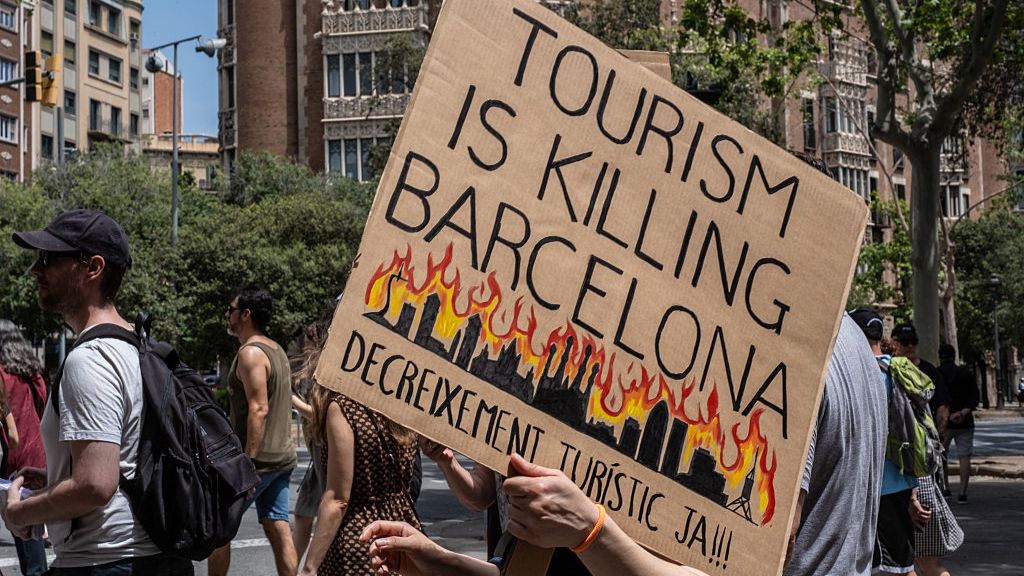
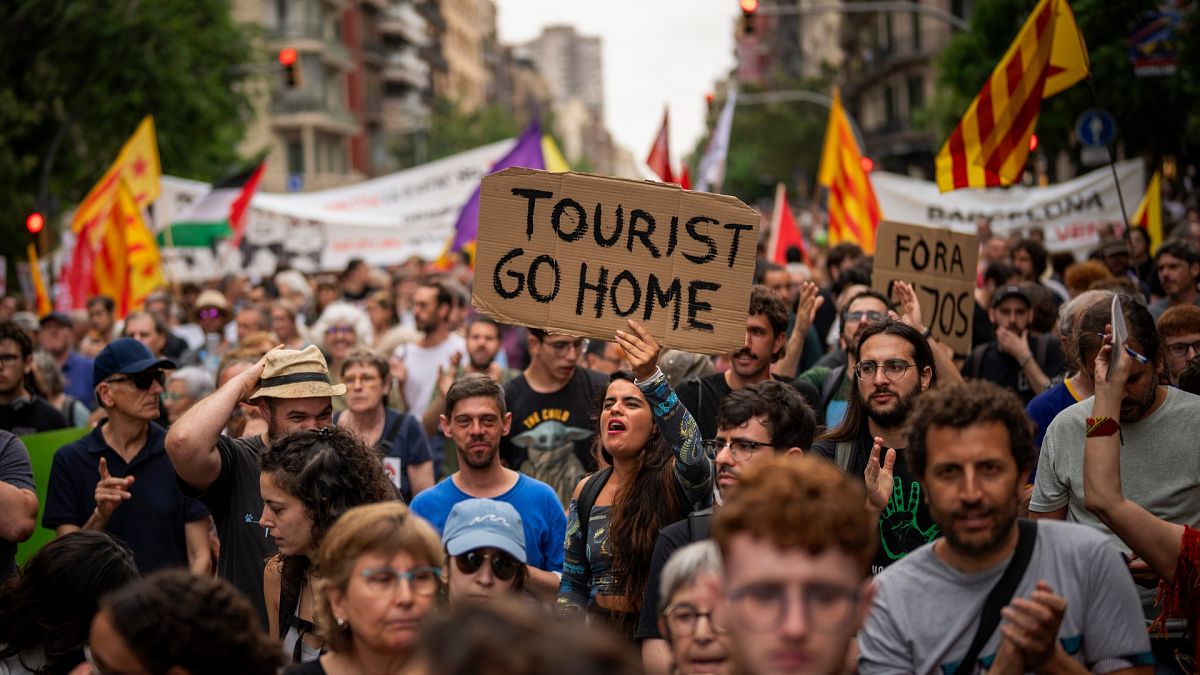
    After a late night out, I was awoke by a noise outside of the Generator Hostel. It was a giant anti-tourism protest happening after all of the built up tension between the locals and the tourists. This is because the citizens of Spain are being kicked out of their homes because of Airbnbs and similar rental agencies to host tourists instead of the people that have been living there for decades. A huge group of protestors came down the street chanting and waving signs. They were there to make a statement against pro-tourism residences, which locals see as the problem of the tourism problem in their country. A TikTok that came up on my feed showed locals spraying tourists with water guns and yelling at them.

Spain tourism: The protesters and residents pushing back on tourism in  Barcelona   

 In POL 150, we've talked about power and public space. As I watched the protesters demonstrate their movement, I noticed that tourism has become a political issue where locals are demanding accountability from businesses and governments that profit from the tourists while kicking locals out. The protests have become a way to say that this is still their home. The reaction from the workers and guests was disgust and annoyance which shows how easily people can dismiss protest and be offended by it. 

Barcelona protesters spray visitors with water: Why has Europe fallen out  of love with tourism? | Euronews

    This was a protest, but it was also a collision of worlds and as we've learned about freedom and rights, but in Barcelona I have learned about what happens when people feel that their social contract has been terminated. This sparks debate about who has the right to shape the future of the city and who belongs in public spaces. This almost turns from a political debate to a humanitarian one where the future can be determined by politics but also humanitarian rights. 

Week 3 POL 150: Intro to Girona

 Week 3 POL 150: Intro to Girona


    This week ended with us taking our journey to Girona. It was super hot out, but it was very beautiful with the scenery looking similar to Barcelona but more calm and fancy. We saw the cathedral where Game of Thrones filmed scenes of King's Landing. Other than the crazy Game of Thrones references this visit helped me think about the political history and symbolism used in this region of Spain. 


    The cathedral was used as a statement of power in religious and political settings. In POL 150 we've talked about how institutions play roles in shaping the political authority in a country. After looking up the background of the church, I found out that the Catholic Church had heavy control over peoples lives, because so many people strongly believed in the Catholic religion. Our tour guide also told us about how people live and die about their religion, such as when the jews were told to convert to Catholicism or leave Spain, so they left.


    Girona has become a huge space for Catalan identity. When walking the streets I noticed many Catalan independence flags which connected to the teachings about liberalism and autonomy. The divide between authority and regional autonomy brings up the question about who should have what power? I learned about how political thought is all around us in our everyday lives from old cathedrals to street graffiti and flags. I've learned about how symbolism is a reoccurring theme in our journeys throughout Spain. Our environment can help us more to understand political theory. Girona gave me some great pictures and gave me lens to see into the political thought of the nation. 


Monday, June 16, 2025

Week 2 (POL 130) Chocolate Museum and Fascism

 Week 2 (POL 130) Chocolate Museum and Fascism 


    This week I visited the Chocolate Museum in the Born District of Barcelona. The museum showed the history of cacao and its early use by the Aztecs who saw it not only as an edible treat, but as a currency. They used it to trade, pay taxes, and pay tribute to their rulers. This connects to our POL 130 teachings about power and economic systems. Anything that relates to money is always political and used by the commonwealth and the people in power. Later on in history, the European colonizers brought cacao back to Europe which made it a luxury and a status piece. When the old systems and meanings of cacao were destroyed it was clear that colonialism seizes things other than land such as values, meanings, and even systems of trade. 


    After the museum I noticed a porta potty that was graffitied with an insert about fascism which instantly made me think about our POL 130 class. It said Fascistas fuera del barrio which means Fascists out of the neighborhood. This act of vandalism reminded me that Spanish politics are still rooted by its fascist past, especially Franco's fascist dictatorship. Spain's transition to Democracy was fairly recent, happening in the 1970's and tensions are still high between left and right wing parties trying to claim political power. 


    The graffiti was a political act of resistance, showing who does and doesn't belong in their community. It connects to the topics of public space, protest, and political memory. In Barcelona you notice that the politics of identity are out on the walls, sidewalks, stores, public transits, and even porta potties. 

Week 4 POL 150: Saint John's day

 Week 4 POL 150: Saint John's day On the night of Sant Joans Day we were in Girona and there were bonfires, fireworks, music, and dancin...